- Department Overview
- HOD Desk
- Department Vision
- Department Mission
- Program Educational Objectives (PEO's)
- Program Specific Outcomes
- Faculty List
- Lab Details
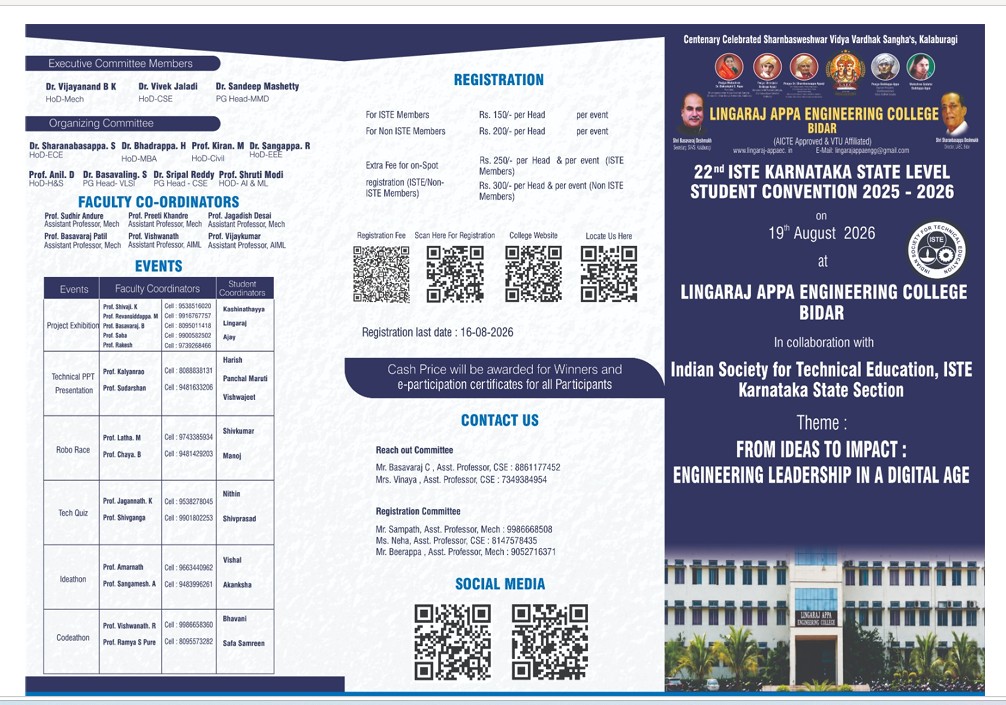
- Events
- Innovative Teaching Methods
- Best Projects
- Placement and Higher Studies
- ME Topper List
- Result Analysis
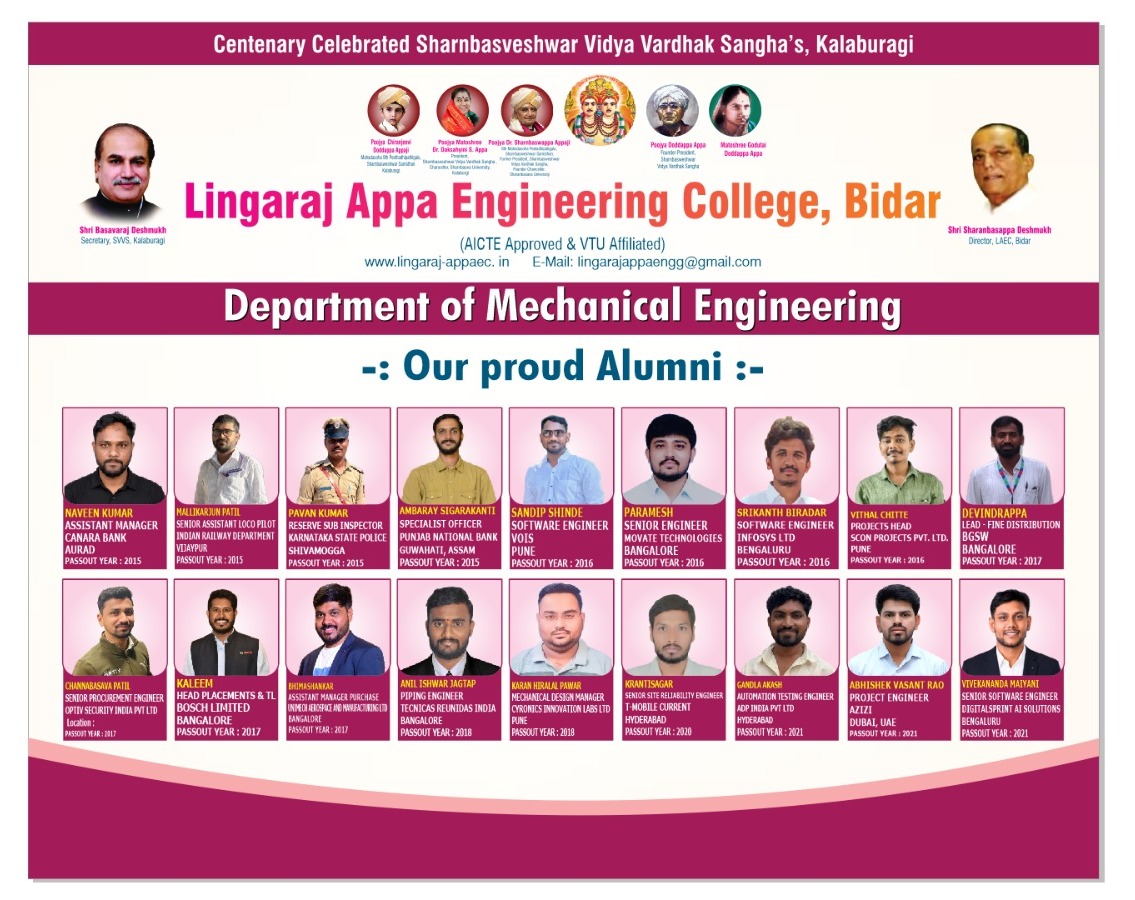
- Prominent Alumni
- Student Information
| Department Overview |
The department of Mechanical Engineering was established in the academic year 2011, Currently Department has an intake of 30. Department has well equipped laboratories, workshops and other infrastructural facilities. Students of mechanical Engineering are exposed to the latest topics in the areas of Design, Manufacturing, Thermal, Material Science and Materials Engineering as per the requirement of the industry. The primary focus of our program is to impart technical know-how to students in cutting edge technology and enhance their problem solving skills through innovative methods of teaching. Our department has centralized facilities mainly CAED lab in which the students of all the branches get trained basics of engineering drawing. A department also offer master degree course M.Tech. in Machine Design. Student of M.Tech has got VTU rank in the academic year 2018-19.
| H.O.D Desk |

Assoc. Prof and H.O.D
Department of Mechanical Engineering
Our department imparts knowledge to students in all the areas like design, manufacturing, thermal, control engineering, mechanics, production, etc., from a research-oriented perspective. Trained & skilled students are shifting to campuses selected by reputed MNCs. Our laboratories are well-equipped with infrastructure like Solid Edge, ANSYS, Hydraulics’ MT LAB, CNC and 3-D Printing. We also conduct various programs, webinars, and workshops for all students to gain current updated knowledge. We are providing service for applying for patents and research proposals in India and worldwide. We continue on this journey with our centre of excellence.
| Department Vision |
| Department Mission |
M1. To train the students in developing professionalism and make them socially committed mechanical engineers with morals and ethical values
M2. To impart quality education to create efficient mechanical engineers who can face global challenges
M3. To build competent mechanical engineers in R&D and offer high-quality technical education to fulfil the needs of industry and society.
| Program Educational Objectives (PEO's) |
- Ability of problem solving by adopting analytical, numerical and experimental skills with awareness of societal impact
- To expose students to the latest innovations and trends with a view to inculcate strong research orientation in mechanical engineering as well as in multidisciplinary streams.
- Demonstrate an understanding of the principles of mechanical engineering in solving engineering problems in core and related domains.
- To prepare the students with competency in carrying out research and analysis in the field of Design, Thermodynamics, Industry and Production Engineering in order to meet the requirements society andglobal challenges.
- Student shall pursue quality education in engineering; contribute to the society in general by becoming professional engineer and responsible citizen of the nation.
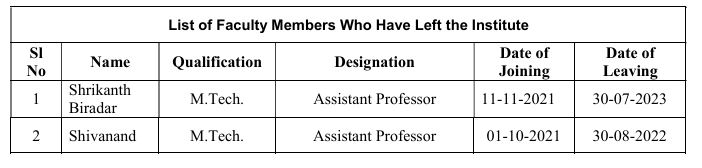
| Mechanical Engineering Department Faculty Details |
| Name | Designation | Qualification | Experience |
| Dr. Vijayanand K | Associate Professor & H.O.D | B.E., M. Tech., Ph. D., | 14.4 |
| Dr. Sandeep M | Associate Professor | B.E., M. Tech., Ph. D., | 12 |
| Prof. Preeti K | Assistant Professor | B.E., M.Tech., | 14 |
| Prof. Sampath K | Assistant Professor | B.E., M. Tech., | 8.5 |
| Prof. Basavaraj P | Assistant Professor | B.E., M. Tech., | 11 |
| Prof. Sudhir A | Assistant Professor | B.E., M. Tech., | 7 |
| Prof. Jitendra S | Assistant Professor | B.E., M. Tech., | 10.2 |
| Prof. Shivaji | Assistant Professor | B.E., M. Tech., | 11 |
| Prof. Beerappa Metre | Assistant Professor | B.E., M. Tech., | 3 |
| Prof. Jagadish Desai | Assistant Professor | B.E., M. Tech., | 8.5 |
|
Lab Details |
| Sl.No | Name of Laboratory | Carpet Area(Sq.mt.) | Major Equipments available |
| 1 | CAED LAB | 200 | Solid edge ST4 software |
| 2 | MATERIAL TESTING LAB | 200 | UTM, Microscope, Polishing Machine |
| 3 | FOUNDRY AND FORGING LAB | 200 | Universal Strength machine, Sand siever, Open hearth furnace |
| 4 | MECHANICAL MEASUREMENTS AND METROGRAPHY LAB | 76 | LVDT,Load cell, sine bar, Autocollimeter, Tool makers microscope |
| 5 | MACHINE SHOP LAB | 200 | Lathe machines, Milling machine, Shaper machine |
| 6 | FLUID MACHINERY LAB | 200 | Compressor, Air blower, |
| 7 | ENERGY CONVERSION LAB | 200 | 4 stroke diesel and petrol Engines, VCR, |
| 8 | HEAT AND MASS TRANSFER LAB | Air conditioner, Forced and free convection, Heat exchanger | |
| 9 | SIMULATION AND ANALYSIS USING ANSYS WORKBENCH | 76 | Ansys software |
| 10 | CNC PROGRAMMING AND 3-D PRINTING LAB | Fonuc OC and Fonuc Om software, CNC lathe machine, CNC 3D Printer | |
| 11 | DESIGN LAB | 100 | Journal bearing, Governor, Gyroscope, Whirling of shaft apparatus |
Department of Mechanical Engineering
| Sl. No. | Date | Academic Year | Name of the Industry | No. of Students visited | Learning Outcome |
| 1 | 18/09/2023 | 2022-23 | GOVERNMENT TOOL ROOM & TRAINING CENTRE- HUMANABAD | 25 | GTTC (Government Tool Room & Training Centre) aims to bridge the gap between classroom learning and modern industrial needs. Its primary goals are training youth in industry-specific skills, upgrading technology for small businesses, and supplying high-quality, precision tools to manufacturers. |
| 2 | 08/10/2024 | 2023-24 | GOVERNMENT ITI BIDAR | 30 | ITI(TATA) aims to bridge the gap between classroom learning and modern industrial needs. Its primary goals are training youth in industry-specific skills, upgrading technology for small businesses, and supplying high-quality, precision tools to manufacturers |
Innovative Teaching Methods.
- Lectures: Classroom lectures effectively deliver theoretical knowledge through logical explanations and numerical problem-solving. Faculty members use interactive teaching techniques to encourage student participation and improve learning outcomes.
- Tutorials: Tutorial sessions provide students with an opportunity to dive deeper into numerical and logical problem-solving courses.
- Presentations Using Audio-Visual Aids: Presentations are used to illustrate complex engineering concepts visually using graphics, animations, and real-world data. Videos showcasing practical engineering applications help students to better understand the impact of technology. These sessions are followed by interactive discussions, where students can ask questions and exchange ideas.
- Laboratory-Based Learning: Students apply theoretical concepts in practical lab sessions, reinforcing their understanding through hands-on experience. Open ended experiments beyond syllabus allowing students to explore concepts creatively, develop critical thinking and engage in real-world problem-solving.
- Collaborative Learning: A group-based educational approach where students work together to solve problems, complete projects, and share ideas. Enhances teamwork, communication skills, and problem-solving abilities.
- Think and Speak: Students are assigned specific topics and asked to think critically and present their ideas in front of their peers. This method helps improve confidence, articulation, and public speaking skills.
- Flipped classroom: A flipped classroom is a teaching approach where students acquire foundational knowledge before class, often through videos or readings, and then use class time for active learning, such as problem-solving, group work, and discussions.
- YouTube videos: NPTEL videos are part of the National Programms on Technology Enhanced Learning, offering a vast repository of free, high-quality educational content.
- Poster presentation: Poster presentation is a visual display of projects and ideas which are presented in a public setting such as seminar and exhibition. It helps students to connect with others, improve the presentation skills and confidence, it provides a platform to share ideas with wider audience.
- Project Based Learning: It is an integral part of the curriculum, ensuring hands-on learning and practical exposure for students. Students actively engage in projects that help them apply theoretical knowledge to real-world challenges, fostering innovation, problem-solving skills, and technical expertise. Project based Learning ensure that, students are well-equipped with the technical competencies, creativity, and problem-solving skills required for a successful engineering career.
- Quiz: Teachers conduct quiz sessions to help students understand concepts as well as to have a first-hand assessment on students learning.
- Seminars: Students are engaged in Seminars and debates related to current syllabus topics and cutting-edge industrial technologies.
- Workshops: These are interactive, hands-on sessions where participants collaborate to solve problems, develop skills, or achieve specific goals under the guidance of a facilitator.
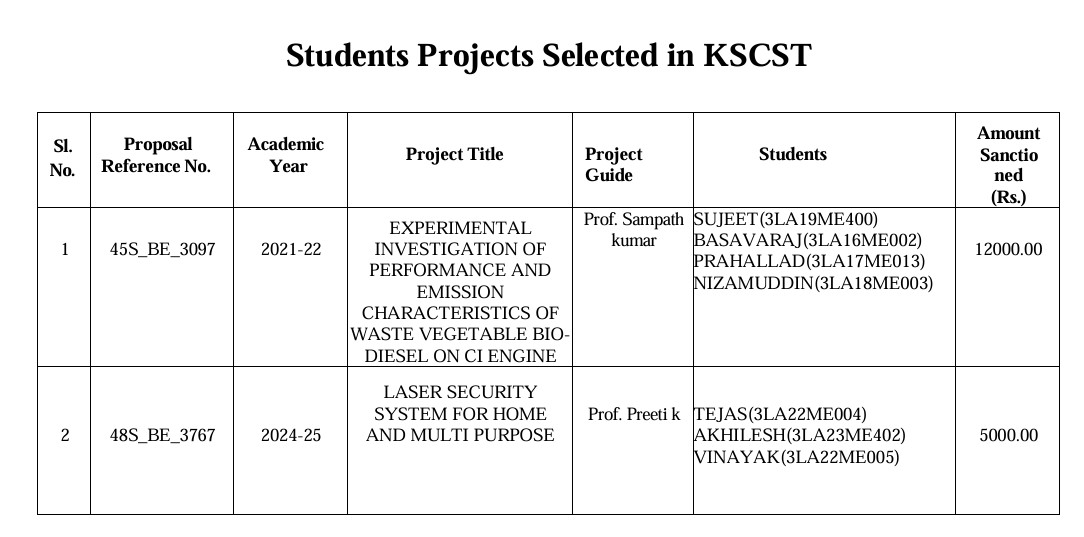
Best Projects of Mechanical Engineering
| Pass Out Year | Department | Total Students | In Take | PLACED STUDENTS | Higher Studies | Entrepreneurship | Placement Percentage |
| 2022-23 | ME | 60 | 13 | 1 | 0 | 0 | 1.67 |
| 2023-24 | ME | 60 | 9 | 4 | 0 | 0 | 6.67 |
| 2024-25 | ME | 60 | 18 | 7 | 1 | 0 | 13.33 |
| 2025-26 | ME | 60 | 10 | 6 | 0 | 0 | 10.00 |
Odd Sem Toppers 2025-26

UG Student Information
| ME STUDENT LIST 2025-26 |
| ME STUDENT LIST 2024-25 |
| ME STUDENT LIST 2023-24 |
| ME STUDENT LIST 2022-23 |
PG Student Information
| MMD Student List 2024-25 |
| MMD Student List 2023-24 |
| MMD Student List 2022-23 |