- Department Overview
- HOD Desk
- Department Vision
- Department Mission
- Program Educational Objectives (POE'S)
- Program Specific Outcomes (PSO'S)
- Faculty List
- Lab Details
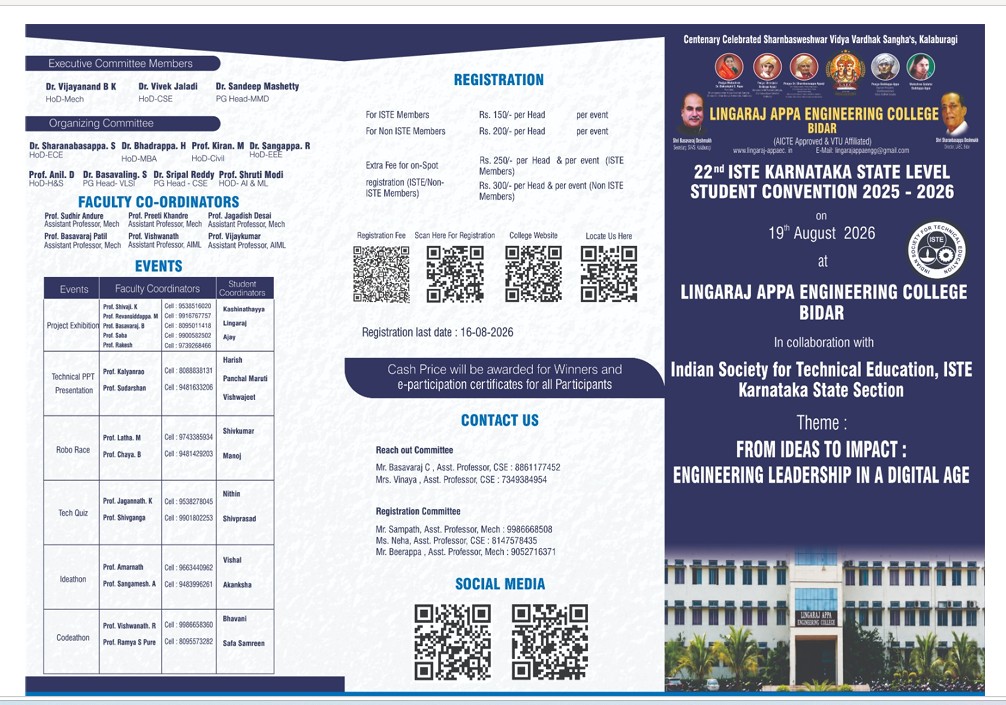
- Events
- Innovative Teaching Methods
The Department of Artificial intelligence and Machine Learning was established in the Institution during 2025. It is one of the Prestigious and Core department in the Institution, offering a UG program with an intake of 60 students. Prof. Shruti Modi is Head of the Department.
The department is strengthened with 4 Assistant Professors, and 1 Technical staff. The department has well-equipped laboratories with state-of-art infrastructure, a department library, and internet facilities. The Department endows with additional industrial training, live projects & hands-on to enhance employability.
 Prof. Shruti Modi
Asst. Prof & H.O.D Department of Artificial Intelligence and Machine Learning.
Prof. Shruti Modi is a distinguished academic professional with over a decade of experience in higher education. She currently serves as the Head of the Department of Artificial Intelligence and Machine Learning at Lingraj Appa Engineering College, Bidar, Karnataka — a role in which she leads curriculum development, departmental research initiatives, and student mentorship.
Prof. Shruti Modi is currently pursuing her Ph.D. from Sharnbasva University, Kalaburagi, reflecting her commitment to advancing knowledge at the frontier of computing. She holds a Master's degree in Computer Networks from the Appa Institute of Engineering and Technology, Kalaburagi, affiliated with Visvesvaraya Technological University (VTU), Belagavi.
Her academic expertise spans Computer Networks, Image Processing, Analysis and Design of Algorithms, Artificial Intelligence, and Machine Learning. With a strong foundation in both theoretical and applied computing.
Department Vision
To be a center of excellence in Artificial Intelligence and Machine Learning, developing innovative solutions and ethical practitioners who contribute to technological advancement and societal welfare."Department Mission
1.To deliver comprehensive AI/ML education that combines technical expertise with ethical considerations, preparing students to be responsible AI practitioners who understand the societal impact of intelligent systems.
2. To create a collaborative ecosystem fostering creativity, critical thinking, and hands-on experience with cutting-edge technologies, enabling students to solve real-world problems independently.
3. To develop industry-ready, ethically grounded AI/ML professionals through strong partnerships and real-world innovation.
4. To promote interdisciplinary learning and exposure to diverse AI/ML applications across various domains, preparing students for global competency in the evolving AI landscape.
Program Educational Objectives (POE'S)
1. To provide quality education in AI and ML, fostering innovation, problem-solving, and industry-ready skills. 2. To promote research, innovation, and real-world application of AI and ML technologies. 3. To equip students with modern AI/ML tools and prepare them for industry and societal challenges.Faculty List
| Name | Designation | Qualification | Experience |
| Prof. Shruti Modi | Assistant Professor & H.O.D | B.E., M.Tech., (Ph. D.,) | 12 |
| Prof. Sanjeevkumar | Assistant Professor | B.E., M.Tech., | 20 |
| Prof. Vijaykumar | Assistant Professor | B.E., M.Tech., | 3.5 |
| Prof. Vishwanath Reddy | Assistant Professor | B.E., M.Tech., | 10 |
Lab Details
Innovative Teaching Methods.
- Lectures: Classroom lectures effectively deliver theoretical knowledge through logical explanations and numerical problem-solving. Faculty members use interactive teaching techniques to encourage student participation and improve learning outcomes.
- Tutorials: Tutorial sessions provide students with an opportunity to dive deeper into numerical and logical problem-solving courses.
- Presentations Using Audio-Visual Aids: Presentations are used to illustrate complex engineering concepts visually using graphics, animations, and real-world data. Videos showcasing practical engineering applications help students to better understand the impact of technology. These sessions are followed by interactive discussions, where students can ask questions and exchange ideas.
- Laboratory-Based Learning: Students apply theoretical concepts in practical lab sessions, reinforcing their understanding through hands-on experience. Open ended experiments beyond syllabus allowing students to explore concepts creatively, develop critical thinking and engage in real-world problem-solving.
- Collaborative Learning: A group-based educational approach where students work together to solve problems, complete projects, and share ideas. Enhances teamwork, communication skills, and problem-solving abilities.
- Think and Speak: Students are assigned specific topics and asked to think critically and present their ideas in front of their peers. This method helps improve confidence, articulation, and public speaking skills.
- Flipped classroom: A flipped classroom is a teaching approach where students acquire foundational knowledge before class, often through videos or readings, and then use class time for active learning, such as problem-solving, group work, and discussions.
- YouTube videos: NPTEL videos are part of the National Programms on Technology Enhanced Learning, offering a vast repository of free, high-quality educational content.
- Poster presentation: Poster presentation is a visual display of projects and ideas which are presented in a public setting such as seminar and exhibition. It helps students to connect with others, improve the presentation skills and confidence, it provides a platform to share ideas with wider audience.
- Project Based Learning: It is an integral part of the curriculum, ensuring hands-on learning and practical exposure for students. Students actively engage in projects that help them apply theoretical knowledge to real-world challenges, fostering innovation, problem-solving skills, and technical expertise. Project based Learning ensure that, students are well-equipped with the technical competencies, creativity, and problem-solving skills required for a successful engineering career.
- Quiz: Teachers conduct quiz sessions to help students understand concepts as well as to have a first-hand assessment on students learning.
- Seminars: Students are engaged in Seminars and debates related to current syllabus topics and cutting-edge industrial technologies.
- Workshops: These are interactive, hands-on sessions where participants collaborate to solve problems, develop skills, or achieve specific goals under the guidance of a facilitator.