- Department Overview
- HOD Desk
- Department Vision
- Department Mission
- Program Educational Objectives (PEO's)
- Program Specific Outcomes (PSO's)
- Faculty
- Lab Details
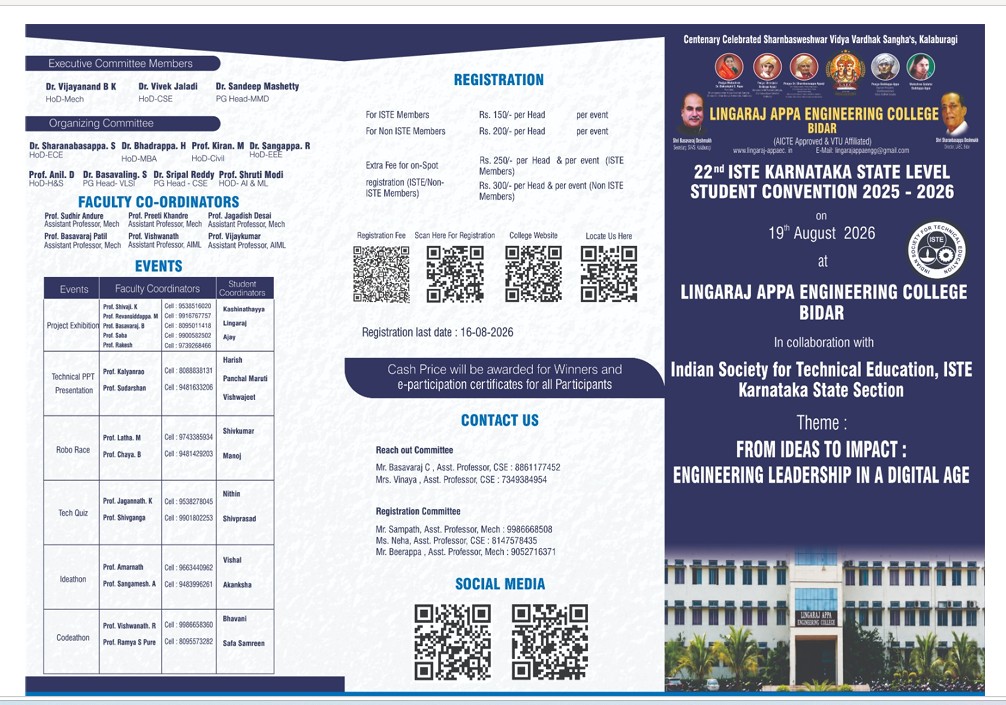
- Events
- Research and Development
- Placement & Higher Studies
- Department Committees
- Innovative Teaching Methods
- Professional Body Details
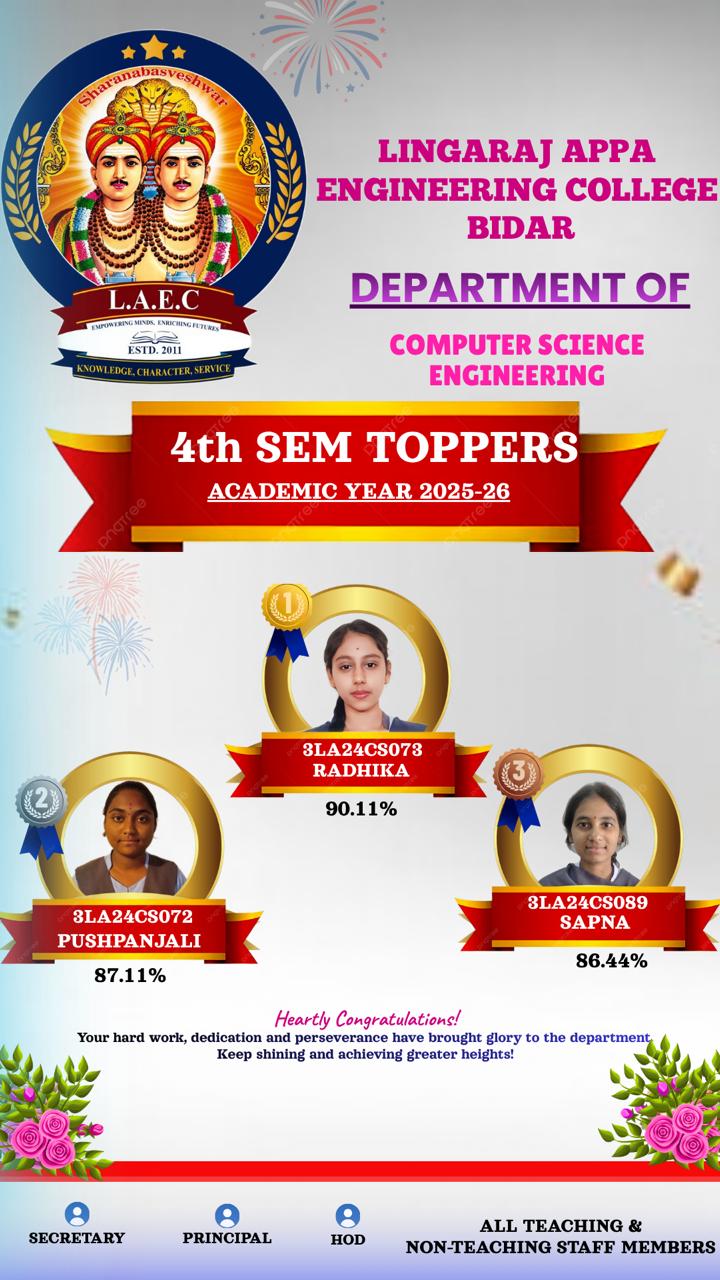
- CSE Topper's
- Best Project
- Result Analysis
- Prominent Alumni
- Students Information
The Department of Computer Science and Engineering was established in the Institution during 2011. It is one of the Prestigious and Core department in the Institution, offering a UG program with an intake of 120 students and PG program in Computer Science and Engineering with an intake of 18. Dr. Viveka Jaladi is Head of the Department.
The department has well-equipped laboratories with state-of-art infrastructure, a department library, and internet facilities. The Department endows with additional industrial training, live projects & hands-on to enhance employability.
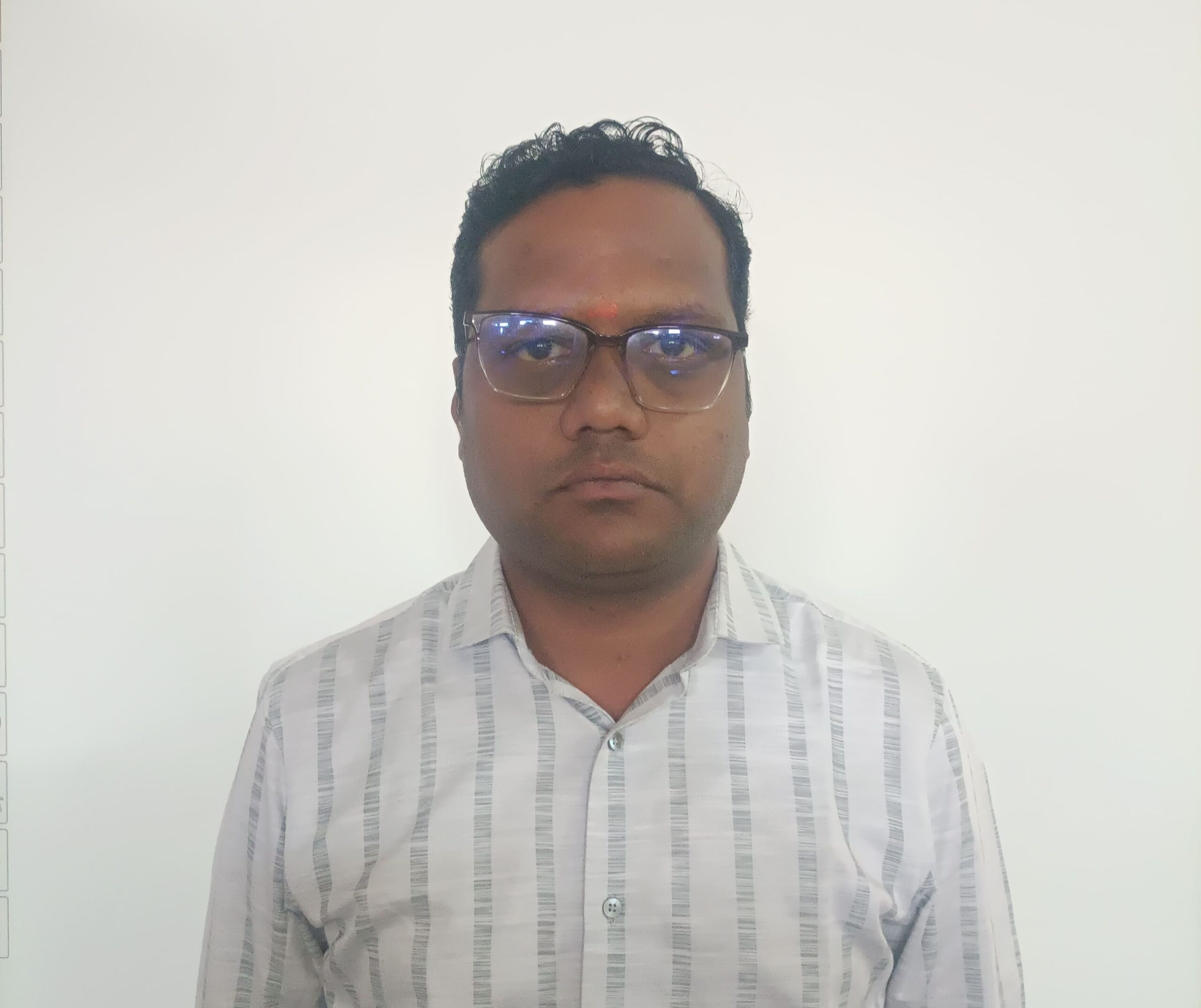
Dr.Vivek Jalade
HoD & Professor
Department of Computer Science and Engineering
Expert Professor with 12 years of experience and expertise in Electrical, Electronics and Communication Engineering Sciences. Exceptional ability to help students achieve success in learning curriculum material development. Encouraged students' ability to think critically and participate in all technical discussions in the course of Engineering (BE/ MTech) by implementing a variety of teaching methods and techniques. Incorporated discipline into lesson plans as a means of increasing student concentration, interactive sessions and active participation in class and developed a sense of accountability for their own progress. Consummate experience in managing Engineering college and its various departments, while working at array of levels as Principal In charge, Head of Department, Professor, Controller of Examination for University Examinations, Internal/ External chief-examiner, Workshop and Program Coordinator, Events Management, etc.
Vision of the Department
To be a front runner in Computer Science and Engineering Education, Fostering Innovation, Creativity and Societal Impact.MISSION
M1: Foster a Culture of Continuous Learning, Critical Thinking, Problem Solving, Preparing Students to adopt and innovate in the face of technological advancements.
M2: Empower graduates to become responsible global citizens to leverage technology for the betterment of society.
M3: Build strong collaboration with industry, academia to exchange knowledge, facilitate internships.
PEO1: Graduates will apply core knowledge of Computer Science and Engineering to analyze, design, and develop computing solutions for industry and societal needs.
PEO2: Graduates will pursue successful careers, higher studies, research, or entrepreneurship by adapting to emerging technologies and professional challenges.
PEO3: Graduates will demonstrate ethical values, teamwork, leadership qualities, and social responsibility while engaging in lifelong learning.
PSO 1: Graduates will be able to analyze, design, and develop efficient computer-based solutions using core computer science concepts, modern programming languages, data structures, algorithms, and system architectures to solve real-world and societal problems.
PSO 2: Graduates will demonstrate the ability to apply emerging technologies such as artificial intelligence, data science, cloud computing, cybersecurity, and software engineering practices to meet industry needs, research challenges, and entrepreneurial opportunities.
PSO 3: Alumni will exhibit professional ethics, teamwork, communication skills, and social responsibility, enabling them to adapt to global and cross-cultural environments while contributing positively to society and lifelong learning.
| Computer Science & Engineering Department Staff List |
| Name | Designation | Qualification | Experience |
| Dr. Vivek Jaladi | Professor & H.O.D | B.E., M. Tech., Ph.D., | 15 |
| Dr. Sripal Reddy | Associate Professor | B.E., M. Tech., Ph.D., | 12 |
| Prof. Neelambika | Assistant Professor | B.E., M. Tech., (Ph. D) | 12 |
| Prof. Basavarajappa | Assistant Professor | B.E., M. Tech., | 7.5 |
| Prof. Ramya S Pure | Assistant Professor | B.E., M.Tech.(Ph. D) | 17 |
| Prof. Basavaraj Shrishail | Assistant Professor | B.E., M. Tech., (Ph. D) | 7.6 |
| Prof. Vinaya | Assistant Professor | B.E., M. Tech., | 2.5 |
| Prof. Zeba Bakhtiyar | Assistant Professor | B.E., M. Tech., | 2.5 |
| Prof. Pramod Khasge | Assistant Professor | B.E., M. Tech., | 3.5 |
| Prof. Dattathri Kulkarni | Assistant Professor | B.E., M. Tech., | 4.5 |
| Prof. Neha M | Assistant Professor | B.E., M. Tech., | 1 |
| Prof. Saba Ayaan | Assistant Professor | B.E., M. Tech., | 1 |
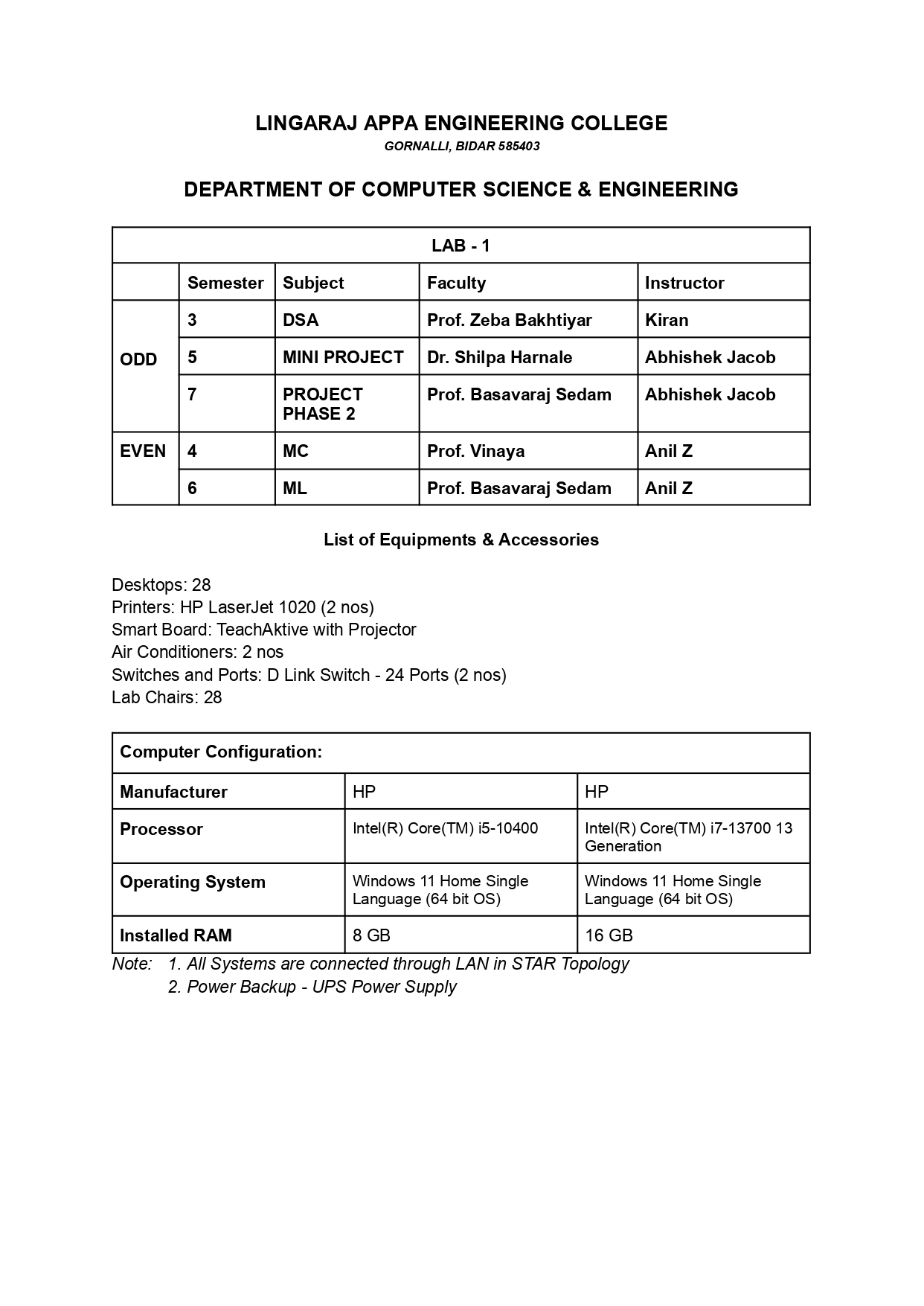
Lab Details
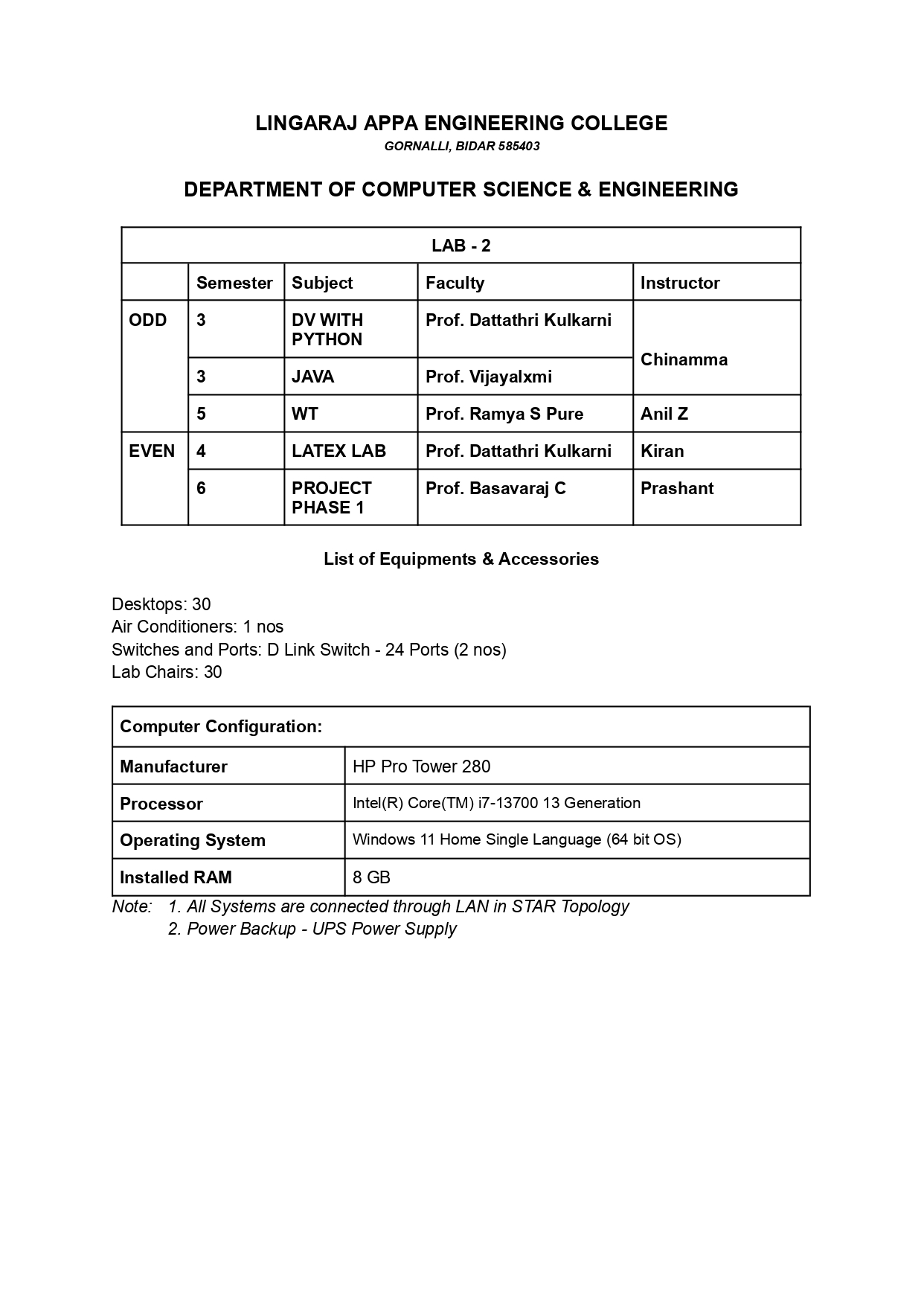
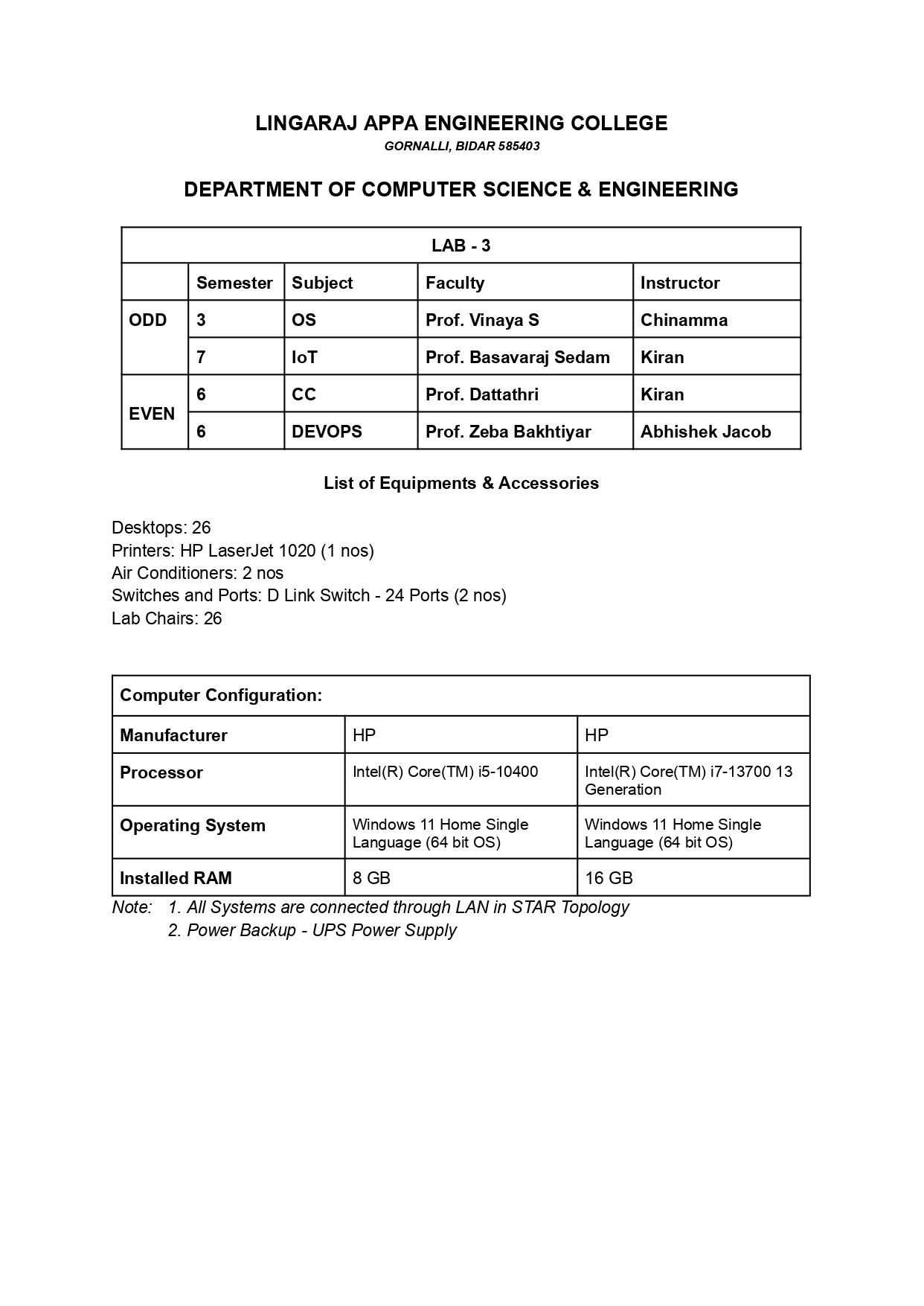
|
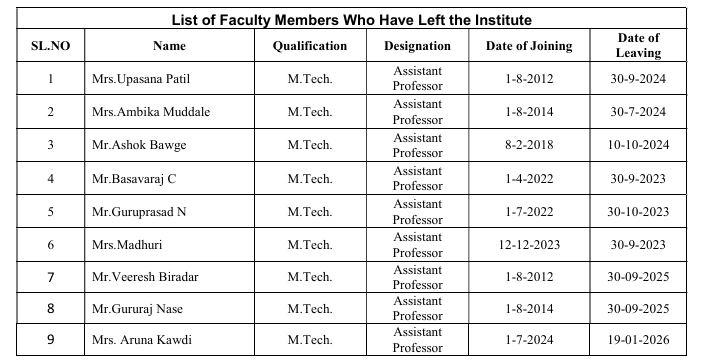
Details of Technical Talks/Workshop and Industry Institute Interaction Programs |
|||
| Sl. No | Name of the Resource Person | Topic | Date |
| 1 | ER. Praveen Kumar Eklare | AWS-Cloud Computing Workshop | 26/04/2025 & 27/04/2025 |
| 2 | Prof. Rajshekhar Gaithond | High-Performance Computing | 07/006/2024 |
| Details of Events Organized in Departments |
|
|
Research and Development
Research Center Approved LetterPlacement & Higher Studies Details
| Year-wise Summary of Placement and Higher Studies (Percentage Calculated Based on Student Intake) | |||||||
| Pass Out Year | Department | In Take | Total Students | PLACED STUDENTS | Higher Studies | Entrepreneurship | Percent (%) |
| 2022-23 | CSE | 54 | 20 | 10 | 0 | 0 | 18.52 |
| 2023-24 | CSE | 54 | 40 | 14 | 2 | 0 | 29.63 |
| 2024-25 | CSE | 54 | 48 | 13 | 3 | 1 | 31.48 |
| 2025-26 | CSE | 54 | 49 | 0 | 0 | 0 | 0.00 |
Innovative Teaching Methods.
- Lectures: Classroom lectures effectively deliver theoretical knowledge through logical explanations and numerical problem-solving. Faculty members use interactive teaching techniques to encourage student participation and improve learning outcomes.
- Tutorials: Tutorial sessions provide students with an opportunity to dive deeper into numerical and logical problem-solving courses.
- Presentations Using Audio-Visual Aids: Presentations are used to illustrate complex engineering concepts visually using graphics, animations, and real-world data. Videos showcasing practical engineering applications help students to better understand the impact of technology. These sessions are followed by interactive discussions, where students can ask questions and exchange ideas.
- Laboratory-Based Learning: Students apply theoretical concepts in practical lab sessions, reinforcing their understanding through hands-on experience. Open ended experiments beyond syllabus allowing students to explore concepts creatively, develop critical thinking and engage in real-world problem-solving.
- Collaborative Learning: A group-based educational approach where students work together to solve problems, complete projects, and share ideas. Enhances teamwork, communication skills, and problem-solving abilities.
- Think and Speak: Students are assigned specific topics and asked to think critically and present their ideas in front of their peers. This method helps improve confidence, articulation, and public speaking skills.
- Flipped classroom: A flipped classroom is a teaching approach where students acquire foundational knowledge before class, often through videos or readings, and then use class time for active learning, such as problem-solving, group work, and discussions.
- YouTube videos: NPTEL videos are part of the National Programms on Technology Enhanced Learning, offering a vast repository of free, high-quality educational content.
- Poster presentation: Poster presentation is a visual display of projects and ideas which are presented in a public setting such as seminar and exhibition. It helps students to connect with others, improve the presentation skills and confidence, it provides a platform to share ideas with wider audience.
- Project Based Learning: It is an integral part of the curriculum, ensuring hands-on learning and practical exposure for students. Students actively engage in projects that help them apply theoretical knowledge to real-world challenges, fostering innovation, problem-solving skills, and technical expertise. Project based Learning ensure that, students are well-equipped with the technical competencies, creativity, and problem-solving skills required for a successful engineering career.
- Quiz: Teachers conduct quiz sessions to help students understand concepts as well as to have a first-hand assessment on students learning.
- Seminars: Students are engaged in Seminars and debates related to current syllabus topics and cutting-edge industrial technologies.
- Workshops: These are interactive, hands-on sessions where participants collaborate to solve problems, develop skills, or achieve specific goals under the guidance of a facilitator.
Topper's of Computer Science and Engineering
Academic Year: 2025-26
4th semester toppers
Result Analysis
Academic Year 2025-26 4th semester result analysis
| OVERALL 4TH SEM RESULT | |||||
| SUBJECT | Attempted | PASS | FAIL | ABSENT | PASS % |
| ADA(BCS401) | 103 | 92 | 11 | 2 | 89 |
| MC(BCS402) | 103 | 63 | 40 | 2 | 61 |
| DBMS(BCS403) | 103 | 74 | 29 | 2 | 71 |
| ADA LAB (BCSL404) | 103 | 97 | 6 | 2 | 94 |
| BCS405A (DMS) | 103 | 68 | 35 | 2 | 66 |
| BCSL456D LATEX LAB | 103 | 96 | 7 | 2 | 93 |
| BIO(BBOC407) | 103 | 90 | 13 | 2 | 87 |
| UHV (BUHK408) | 103 | 94 | 9 | 1 | 91.26 |
| Total | 103 | 39 | 64 | 1 | 37.86 |
Prominent Alumni
UG Students Information
| CSE STUDENTS LIST 2025-26 |
| CSE STUDENTS LIST 2024-25 |
| CSE STUDENTS LIST 2023-24 |
| CSE STUDENTS LIST 2022-23 |
PG Students Information
| CSE STUDENTS LIST SCS 2024-25 |
| CSE STUDENTS LIST SCS 2023-24 |
| CSE STUDENTS LIST SCS 2022-23 |